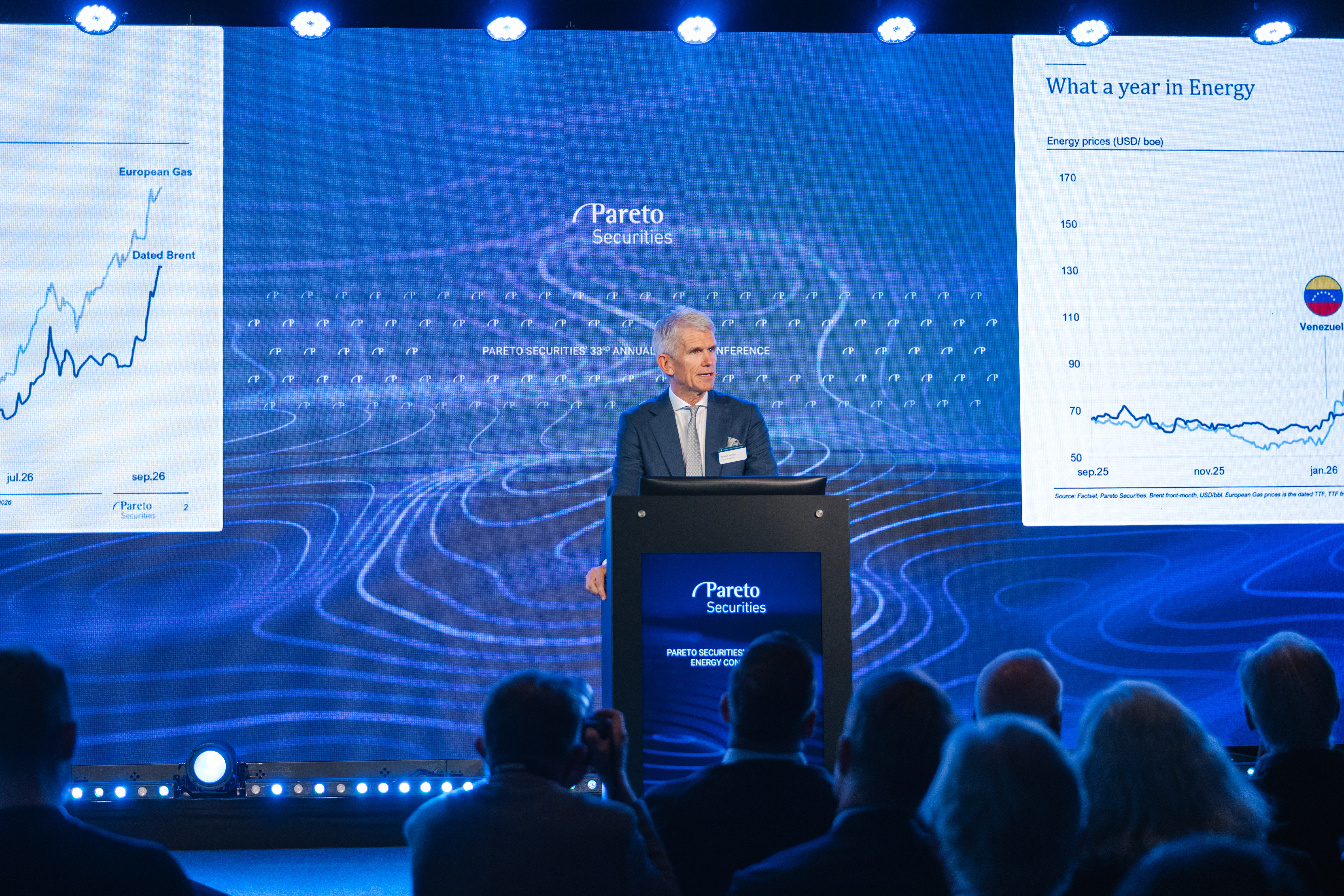
You cannot take your trade lanes for granted. You cannot take goods being delivered on time for granted.
Eirik Haavaldsen, Global Head of Equity Research.
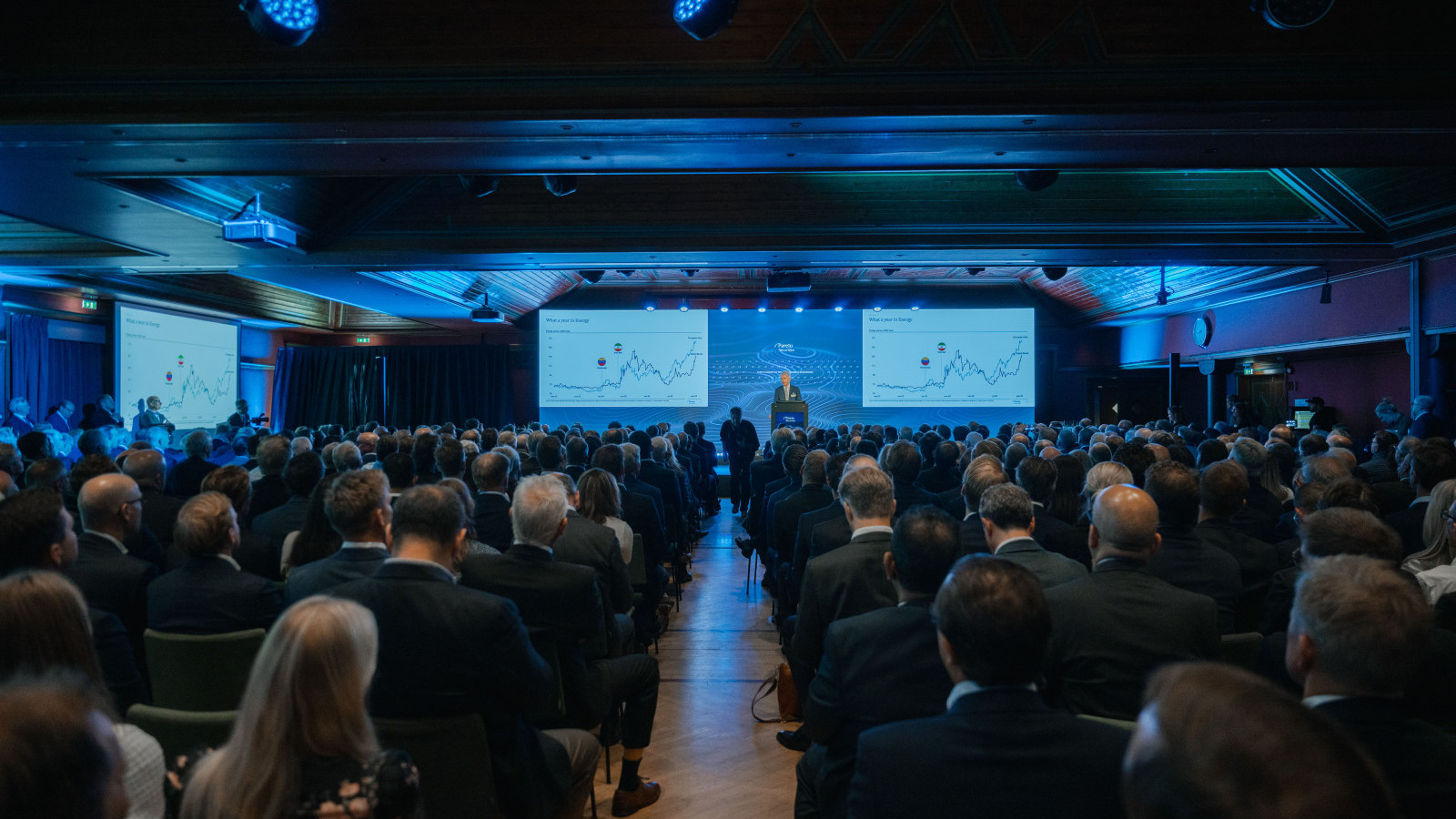
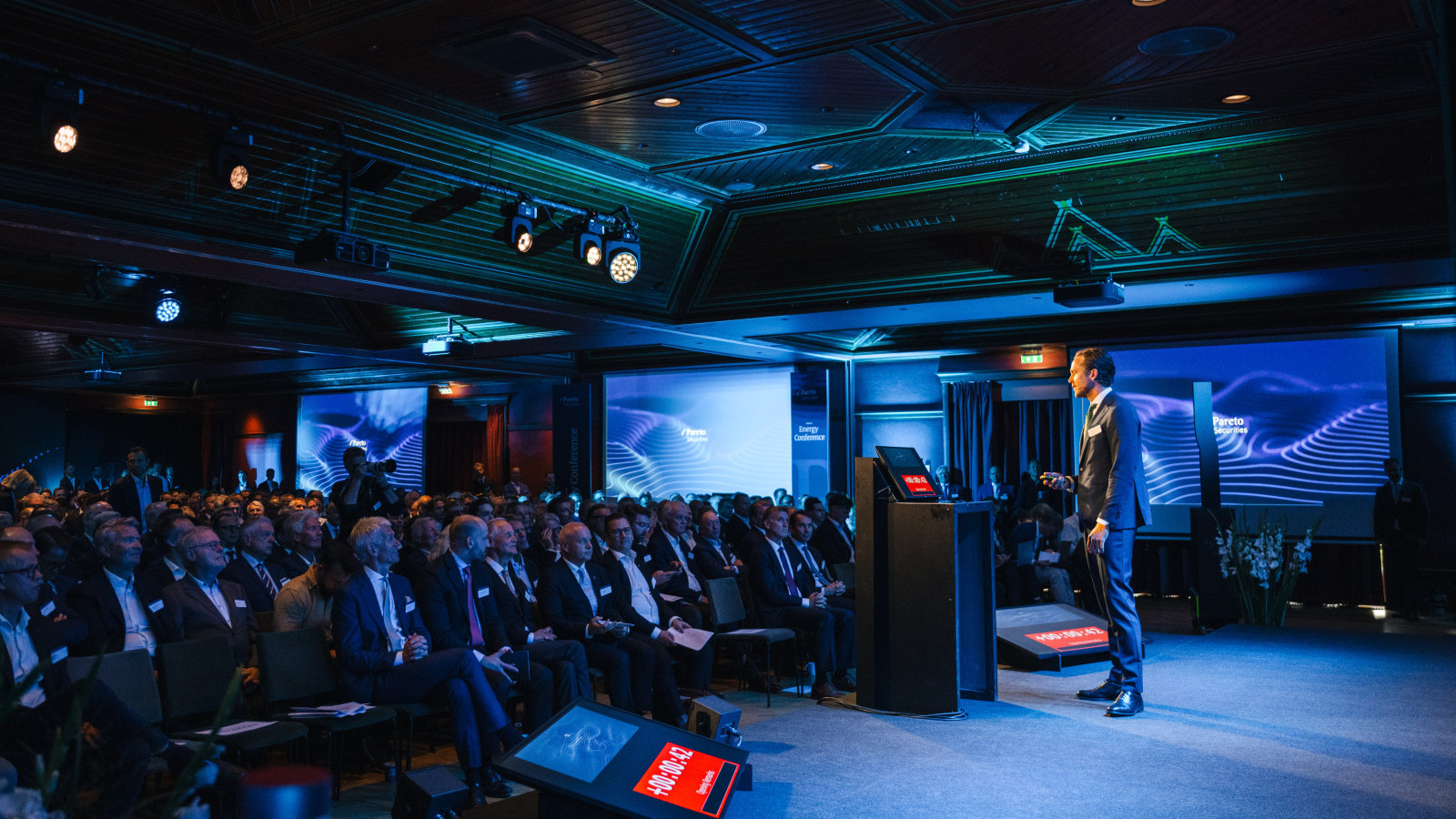
Energy equities have outperformed broader markets over a volatile year. At Pareto Securities' 33rd Annual Energy Conference, around 2,200 investors, business leaders and industry professionals met over 170 presenting companies at Holmenkollen in Oslo. The focus was on energy security, rising demand and record investment in the energy transition.



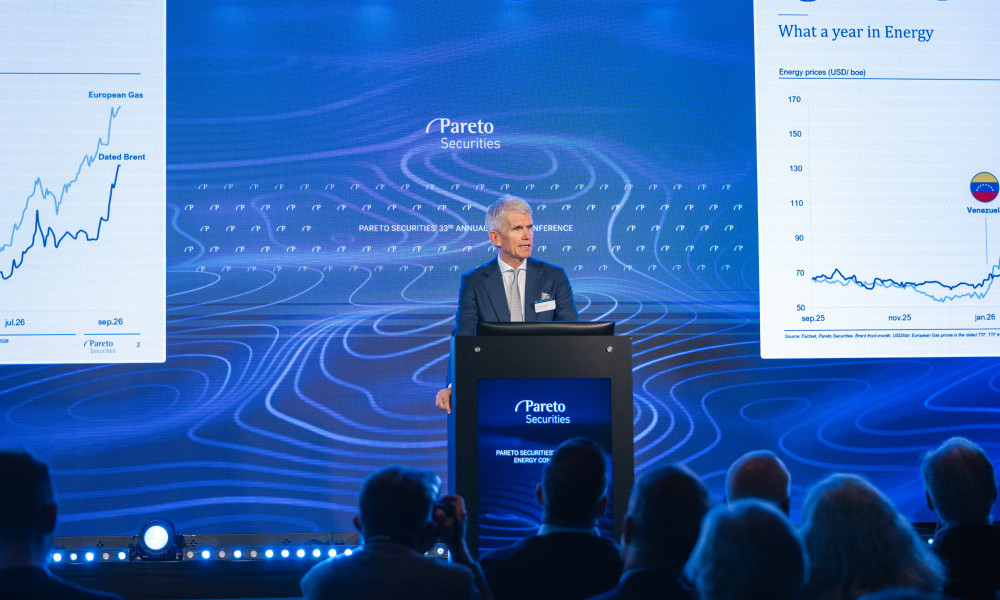
Christian Jomaas during the opening of Pareto Securities' 33rd Annual Energy Conference.
Another Pareto Securities Energy Conference has come to a close in Oslo. Investors and companies met on 16-17 September after a year of strong returns across the energy sector.
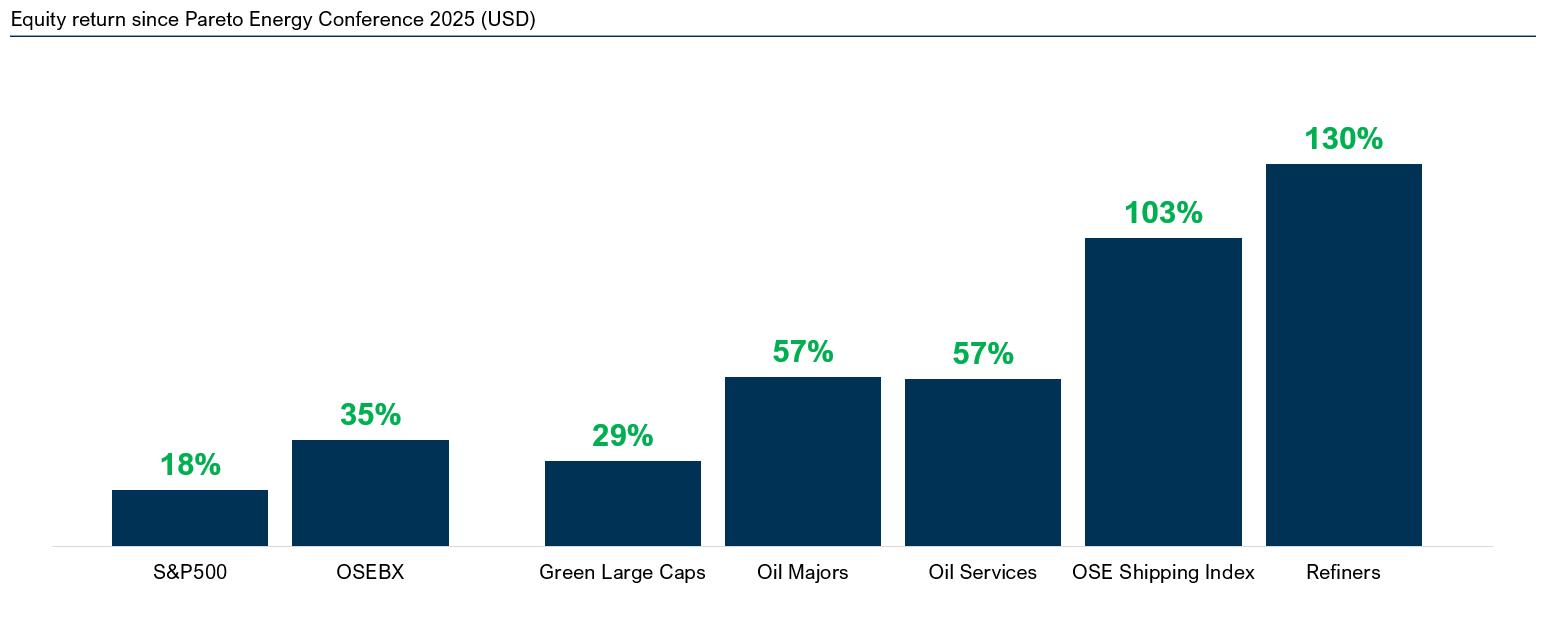
"Since the conference last year, the S&P 500 is up 18 per cent and energy markets have outperformed broader markets. Green large caps are up 29 per cent, oil majors and oil services up 57. Shipping is up a stellar 103 per cent, still beaten by refiners, up 130 and this year's winner," said Christian Jomaas, Global CEO of Pareto Securities, as he welcomed the participants.
Even after a year of strong returns, oil majors remain more modestly valued than the broader market, trading at around 12 times expected 2027 earnings compared with 19 times for the S&P 500.
Oil prices have swung sharply as geopolitical tensions have eased and escalated. By the time of the conference, renewed tensions had pushed oil back above USD 100 per barrel and European gas prices to a three-year high, putting energy security back on the political agenda.
The conflict in the Middle East cut crude flows through the Strait of Hormuz from around 15 to 4-5 million barrels per day, forcing oil onto alternative routes. Greater use of pipelines, increased exports from ports outside the strait and inventory drawdowns have partly offset the loss of supply reaching global markets.
The pressure on refining has been harder to relieve. Damaged infrastructure in the Middle East and reduced crude supply to Asia have cut refinery throughput, tightening supplies of refined products, particularly diesel, and pushing margins to record levels.
"We consume diesel, jet fuel and gasoline, not crude oil," said Eirik Haavaldsen, Global Head of Equity Research at Pareto Securities.
The price of crude alone therefore gives an incomplete picture of the costs facing consumers and businesses. Ahead of winter, middle-distillate inventories were falling when they would normally be building, and refineries in Europe, North America and Asia were already running at close to full capacity. A cold winter or an unexpected outage could push fuel prices considerably higher.



Global investment in the energy transition reached a record USD 2.3 trillion in 2025, around four and a half times the level in 2019. Annual investment in renewables, power grids, energy storage and nuclear power is now almost twice as high as investment in fossil fuels.
Growth in solar and wind production in 2025 was equivalent to around 75 per cent of the average annual increase in primary energy demand over the previous decade, up from 30 per cent in 2020.
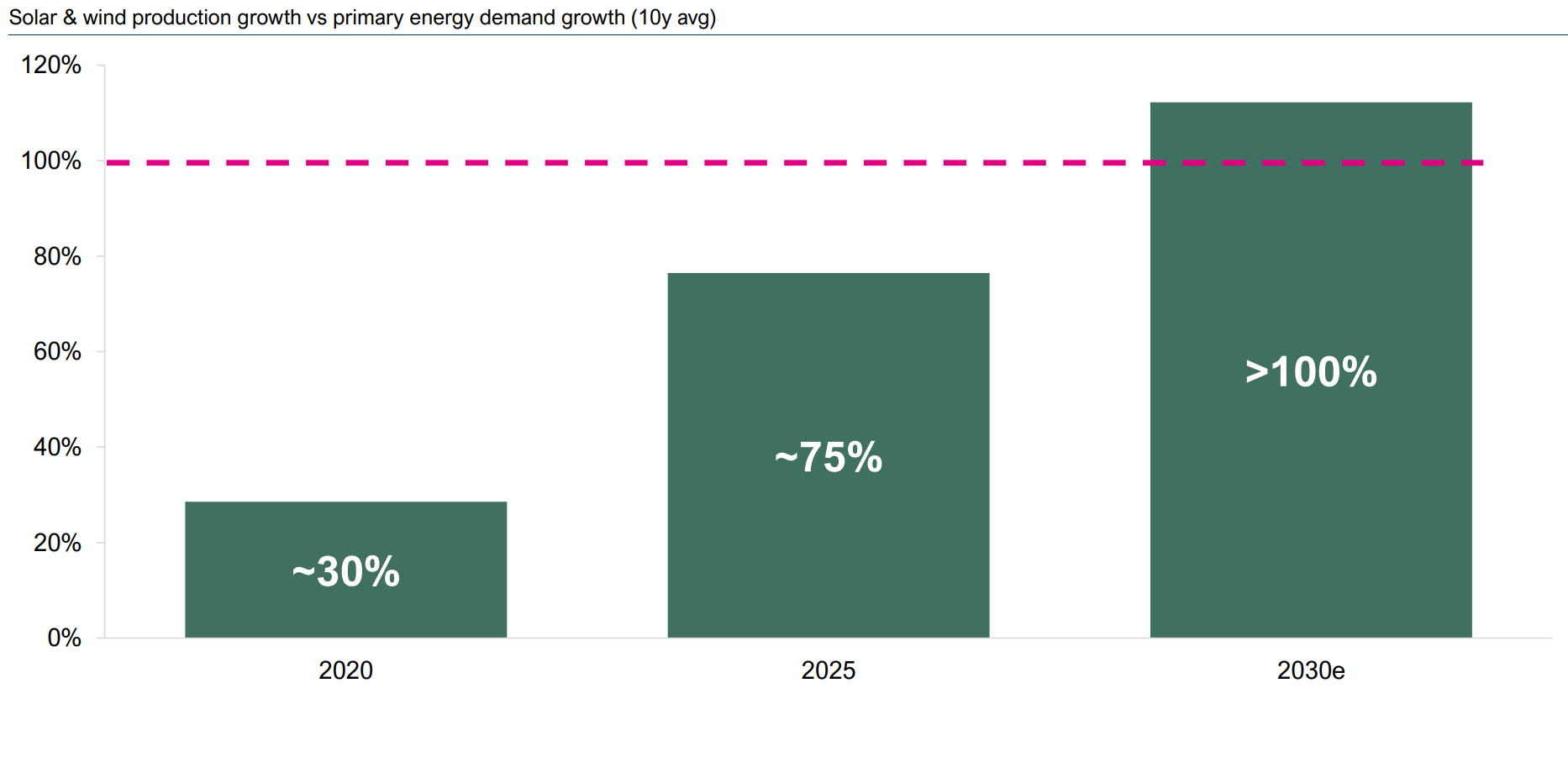
"By 2030, solar and wind will cover more than 100% of all growth in primary energy demand, according to Bloomberg," said Christian Jomaas. "Fossil fuel investments grow, but renewable investments grow more."
Rising energy demand requires continued investment in both renewable and traditional energy supplies. Norway remains a crucial supplier to Europe, providing 31 per cent of the EU's natural gas imports and 13 per cent of its crude imports alongside some 160 TWh of renewable generation. Maintaining that position will require continued activity on the Norwegian continental shelf as well as investment in renewables.
For shipping, 2026 was the fourth consecutive year of disruptions to key trade routes: the Black Sea in 2022, the Red Sea in 2024 and now the Strait of Hormuz.
Shipping has nonetheless prospered. The companies presenting at this year's conference have delivered a value-weighted total return of more than 200 per cent since the 2022 conference, including reinvested dividends. That corresponds to an annualised return of more than 30 per cent.
You cannot take your trade lanes for granted. You cannot take goods being delivered on time for granted.
Eirik Haavaldsen, Global Head of Equity Research.
Tanker earnings have reached levels never seen before, as disrupted trade routes, congestion and delays reduce transport efficiency. Strong refinery margins have added to the urgency of securing crude cargoes, and competition for available vessels has intensified.
Eirik Haavaldsen expects strong tanker earnings to continue into the winter, while warning that current rates would not last. High earnings have encouraged owners to place new orders, with VLCCs accounting for almost 30 per cent of all global vessel orders by deadweight tonnage so far in 2026.
These orders could put pressure on future rates, although an ageing fleet and sanctions limit the number of ships currently available to trade. Almost 20 per cent of the global VLCC fleet is subject to some form of sanctions, while the average age of the fleet is more than 13 years.
The dry bulk companies in Pareto Securities' comparison trade at lower multiples of net asset value than their VLCC peers, several below book value and with solid dividend yields. In Eirik Haavaldsen's view, there is still value to be found in dry bulk.
Energy demand keeps growing, and record investment is flowing into both renewable and traditional supply. At the same time, 2026 has shown how quickly a constraint can tighten.
Tight markets mean high earnings, and high earnings make companies want to grow. The past year has seen numerous acquisitions, most visibly in oil services. Higher valuation multiples and available financing have made it easier to do deals.
"We expect to see more M&A activity across all energy segments going forward," said Christian Jomaas.
Energy has long been a core sector for Pareto Securities, with transactions across the whole chain from production to transport to consumption. This year the best returns came from tankers and refiners. Next year they may come from somewhere else.
"We don't know exactly where the next bottleneck is going to be, but it's going to be somewhere. We believe energy security is going to continue to be a very favourable backdrop for our companies," said Eirik Haavaldsen.
Over the past three decades, Pareto Securities’ Annual Energy Conference has become the largest of its kind in Europe and a significant event in the energy investment community. The conference offers a platform for industry leaders, experts, and investors worldwide to connect, exchange ideas, and forge collaborations.
The 33rd annual conference took place on 16-17 September 2026 at Holmenkollen in Oslo, with 2,200 industry professionals and investors, more than 170 presenting companies, while facilitating over 2,000 investor meetings.
days
hours
minutes
seconds
Reach out to your contact at Pareto Securities to receive our research presentations.

